|
Are you looking for material to prepare your Kindergarten age child to take the Otis-Lennon School Ability Test® (OLSAT®) Level A? You've come to the right place. I explain why I recommend the titles I do immediately below. If you want to get straight to the recommendations scroll down.
The Otis-Lennon School Ability Test® is a multiple-choice test. The children indicate their answers by shading a bubble underneath the picture they choose on the question paper (they don't fill in the scantron form). There is no reading. The test proctor reads the instructions, questions and answers once only. Listening is very important. For the OLSAT® you want to expose your children to verbal, aural, arithmetic, pictorial and figural reasoning activities. The Building Thinking Skills series is a great place to start for verbal and figural reasoning. Add to that Can You Find Me? for pictorial and aural reasoning and Mathematical Reasoning for arithmetic reasoning and you're well placed. The LUK Learning System adds another dimension introducing independent learning and concentration building activities.
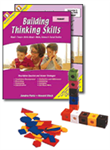
Building Thinking Skills Primary was designed for the typical child in Gr K-1. It's a good place to start browsing but, depending in part on the time of year that you are looking, your child may be ready for the next level in this series. Ignore the writing activies in Building Thinking Skills Primary. Your child can just tell you the answers. The book is designed to be used with manipulative blocks which are sold separately. Without blocks you won't be able to do about 1/4 of the exercises. You could trace the attribute block shapes out of cardboard instead of purchasing the plastic blocks I sell. You could do the same for the interlocking cubes but I strongly recommend that you purchase these. The interlocking cubes easily lead themselves to extension activities in developing more complex sequences (in addition to color each block has a geometric shape cut out which can add another dimension to sequencing) and understanding orientation and constancy of area and volume. Young children learn through play so even though actual blocks won't be used in testing playing with them is an important way for many children to learn some of the skills needed.
Your gifted child may be ready for Level 1 of Building Thinking Skills (for the typical child in Gr 2-3). As with the Primary level don't expect written answers at this stage. Scribe for them, allow them to just tell you the answer or choose the software. Finally if your child needs more practice with non-verbal reasoning Hands on Thinking Skills contains additional activities in this area.
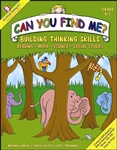
Can You Find Me? is a great choice to use for listening and reasoning. For testing it will be important that your child stays focused and listens to the instructions, questions and answer options. You have a choice of levels. If in doubt I recommend beginning with Can You Find Me? Pre K. This is one series where it doesn't hurt to begin easy. Having the patience to listen carefully to what appear to be easy questions and thereby avoid making a silly mistake is an important skill for young children to develop before testing. Some gifted children don't do as well in screening tests, like the OLSAT®, as they could because they are impatient and don't listen to the entire question before choosing their answer. Another common problem is to look for a more complex pattern or relationship than is intended by the questioner. Using both the Pre K and K levels of Can You Find Me? can help build both these skills within the context of the cognitive skills the OLSAT® tests for.
If you want just one book I can't offer anything that covers the entire skill set tested for in the OLSAT® but recommend that you choose between Building Thinking Skills Level 1 and Can You Find Me? K-1 The best one for you will depend on your child and what they do and don't know already.
While there is no math per se in the OLSAT® questions on arithmetic reasoning are included at this level. As an illustration a question might ask the child to identify the picture of flower with two more flowers than the first picture. The Mathematical Reasoning series has more math that you'll need but it develops this type of reasoning skill. Your gifted child is probably ready for Level B in this series. Again I recommend looking at the sample pages and trying the activites with your child. If they look too difficult then start with Mathematical Reasoning A.
Math Analogies is another good choice for both arithmetic reasoning and verbal and figural reasoning. It uses pictures and numbers to present analogies and the user has to complete analogy pairs.
As with traditional mathematics conventional Language-Arts including topics like reading and grammar are not explictly tested for in the OLSAT®. If your child has English as a second language, or speaks a second language at home, or if you just want to give them a solid grounding in word analysis then Language Smarts is another possibility. This title is, as one would expect, heavy on traditional language-arts activities but it integrates thinking skills into the material so your child will be exposed to the type of reasoning tested for on the OLSAT as they brush up on vocabulary, grammar, reading and writing.
If you have some time the K-1 book bundle offers a selection of the titles recommended and others utilizing the skills in different contexts (only titles published by The Critical Thinking Company are included in this bundle). If you decide to purchase this bundle I strongly recommend adding Building Thinking Skills Level 1 software or book. If your child learns rapidly and doesn't need much repetition you'd probably be better to pick and choose titles than opt for the entire bundle.
The final title in the list of recommendations below is the Spectrum Test Prep book for Gr 1-2. This series was designed to prepare children for conventional standardized tests of reading and math. Despite the difference in focus from the OLSAT® there are a number of questions in this book that are similar in content and format to those on the OLSAT®. In addition practice listening and shading bubbles is very important for some children. There will be problems in this book that will be difficult even for a bright Kindergarten child but I'm not aware of anything like this designed for younger children. Remember as you use this book that your child will not see any words when they take the test. If your child is reading it will be important for you to cover the words and only let them see the pictures as they listen to your instructions so that they can practice focused listening.
If you are in New York your child will be taking the Bracken School Readiness Assessment (BSRA) in addition to the OLSAT®. Mathematical Reasoning, Language Smarts and Can You Find Me? are great choices for this. If you read more about the BSRA you'll see that our recommendations there are very similar to those for the OLSAT®. The range of products sold here was chosen because of their ability to build thinking skills. The fundamental concepts that the BSRA tests for are integrated into the thinking skills activities included in the various products.
OLSAT® and Otis-Lennon School Ability Test® are registered trademarks of NCS Pearson. The recommendations made here are those of Think Tonight and are not endorsed by NCS Pearson.
|
|
|