Building Thinking Skills Level 2 is our number one recommendation if your child is reading confidently at at least a fourth grade level (if not start with
Level 1). This is a Gr 4-6 product covering verbal and nonverbal reasoning. Software is also available which covers the same skills, with the same examples, but the presentation is very different. The choice of book or software is up to you. The presentation of the book is more like that of the test but the software may be more engaging and can be used more independently. Exercises can be repeated more easily with the software enabling a third grader to rework areas they find challenging until they master them. Many of our customers choose to purchase both book and software particularly if they have a short period of time before testing. The book allows for a quick overview and looks more like the actual test but children are frequently willing to spend more time "playing" with software than answering questions in a workbook. Our personal preference is for the book so that highly capable children can skip sections that are easy for them.
Logic is a key skill in any test taking situation. Strong logic skills enable you to eliminate the obviously wrong options and focus on what you really need to do to determine the correct answer. Logic Countdown also has exercises on analogies and sequences. While primarily language based there are some figure and some number questions too.
Visual Discrimination is all about exploring and solving picture patterns. This is what you need to do for the Nonverbal Battery on the CogAT.
Patterns in Mathematics is all about numbers to ensure that a child both has the base mathematical knowledge required and the ability to apply that to number analogies and puzzles and series.
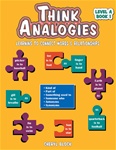
Verbal Analogies is an area where many children benefit from additional work. Think Analogies begins with verbal classification exercises and develops the skills necessary to reason by analogy.
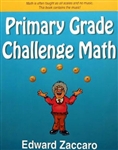
Primary Grade Challenge Math is an excellent math enrichment book. With an emphasis on problem solving it includes number sequences (series) and math function problems (math analogies). Primary Grade Challenge Math challenges a child to use the math they already know to solve problems of a type they haven't seen before. This ability is what the CogAT tests for and a high level of problem solving ability well serve a child well after the test date too.
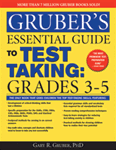
Finally Gruber's Essential Guide to Test Taking was written with an eye to children taking entrance exams for competitive private skills. For the CogAT it has sections on Sentence Completion and Verbal Analogies. It also has a math refresher overview to ensure that your child has the basics off pat. Finally sections on Vocabulary and Reading Comprehension and Writing aren't directly applicable to the CogAT but many children take the CogAT in conjunction with the ITBS or other achievement based test and these sections can be used for that.
Your child may need additional work in one or more areas
More Quantitative ReasoningThe quantitative analysis battery in the CogAT is not about math per se but rather about understanding relationships between numerical concepts and how numbers can be manipulated. If math is not your child's strength you might like to start with Mathematical Reasoning D or Mathematical Reasoning E. The Mathematical Reasoning series integrates reasoning activities into grade level mathematics. If your child is an able math student you do not need Mathematical Reasoning.
Math Analogies presents figural and quantitative analogies. From the quantitative reasoning perspective your child will get exposure to grade level appropriate concepts of measurement and calculation. They'll also learn how to identify the "expected" answer.
For a child who focuses on the algorithm for solving a problem and doesn't do well when presented with novel problems try Scratch Your Brain. The questions don't require complex math but you have to think about how to go about solving them.
More Verbal ReasoningIf your child needs more work in the verbal reasoning area and particularly if they are bilingual we recommend some additional vocabulary titles. Vocabulary Cartoons and Word Roots are different approaches to extending vocabulary. We have a section on our website focusing specifically on Vocabulary.
Analogies is another area where you can never do enough. Working analogy problems develops all the verbal skill areas which will be tested. Additional Analogy titles can be found in our Analogies section.
More Non-Verbal ReasoningIf you'd like further resources to work on your child's non-verbal reasoning ability you'll find a number of other suggestions under our
NNAT recommendatons.Some children need more hands on exercises before they are ready to visualize as is necessary to answer CogAT questions. Games and puzzles can help with this.
Deductive Logic - Avoid Silly Errors?We always recommend Mind Benders for any multi-choice test. These are deductive logic puzzles. This is the skill you use in multi-choice testing to eliminate (a) and (b) as impossible even though you don’t know the answer thereby improving the chance of guessing correctly. They are also great for practicing the type of reading required for multi-choice testing where every word matters. Many able children skim read. For testing they need to practice slowing down and taking account of every word. Book 3 would be a good place to start but we have titles above and below this in difficulty. There are 14 titles in the
Mind Benders series.Software or Book?The choice is up to you and your child. Your child will be exposed to the same skills whichever format you choose. Books are more portable but they don't allow easily for repetition of difficult exercises. Software can be used by multiple children and varying the presentation of material may engage a child's interest for longer. For most of the titles we don't have a strong preference either way. Where we do you can find that information in the detailed product description (click on "more info" after any of the brief descriptions below.)